std::shared_ptr: Shared Ownership of Resources
When working with unique_ptr<T>, you have exclusive ownership - only one pointer can own a resource at a time. But what if multiple parts of your program legitimately need to own the same resource? What if you have a design where several objects should collectively manage a resource’s lifetime?
This is where std::shared_ptr<T> comes in. Unlike unique_ptr<T>, which enforces exclusive ownership, shared_ptr<T> allows multiple owners to share responsibility for a single resource. The resource is automatically cleaned up only when the last owner is destroyed.
What is std::shared_ptr?
std::shared_ptr<T> is a smart pointer that manages a resource through shared ownership. Multiple shared_ptr instances can point to the same resource and collectively manage its lifetime through a reference counting mechanism.
std::shared_ptr<T> consists of two main components: a data pointer and a control block pointer.
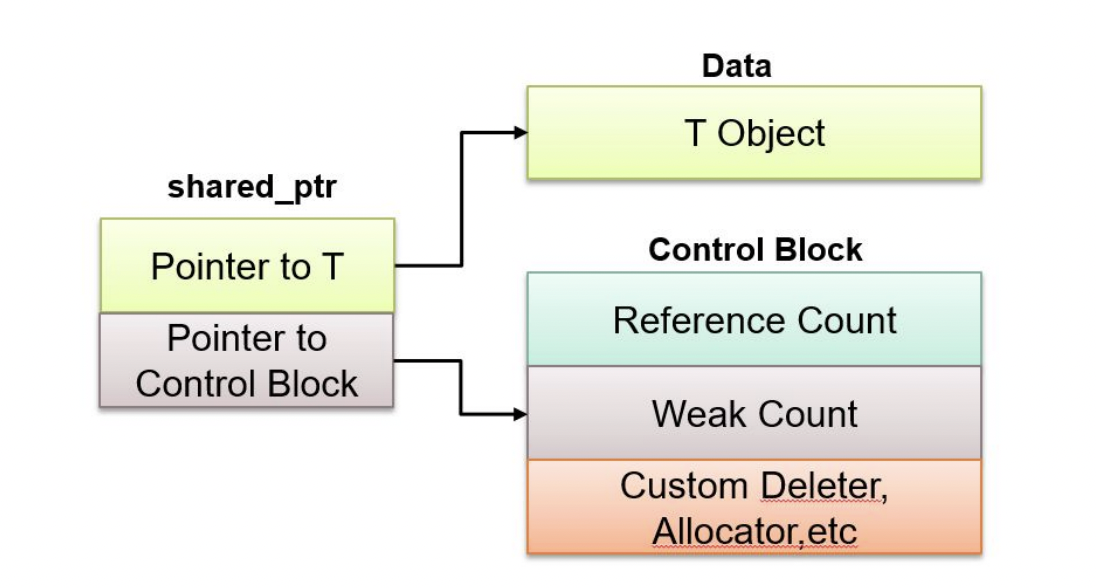
Key Characteristics
- Shared Ownership: Multiple
shared_ptrcan own the same resource - Reference Counting: Internally maintains a count of how many
shared_ptrinstances own the resource - Automatic Cleanup: Resource is deleted only when the last owner is destroyed
- Copyable: Unlike
unique_ptr, you can freely copy ashared_ptr - Movable: You can also move a
shared_ptrto transfer ownership - Reference Counted Overhead: Slightly slower than
unique_ptrdue to atomic reference counting
How Reference Counting Works
Each resource managed by shared_ptr has an associated reference count:
- When created: Count = 1 (one owner)
- When copied: Count increments (more owners)
- When destroyed: Count decrements
- When count reaches 0: Resource is automatically deleted
std::shared_ptr<int> ptr1 = std::make_shared<int>(42);  // count = 1

std::shared_ptr<int> ptr2 = ptr1;  // count = 2

std::shared_ptr<int> ptr3 = ptr1;  // count = 3

// ptr1 goes out of scope    // count = 2
// ptr3 goes out of scope    // count = 1
// ptr2 goes out of scope    // count = 0 -> Memory is deleted
Single shared_ptr
When you create: std::shared_ptr<int> ptr = std::make_shared<int>(42);
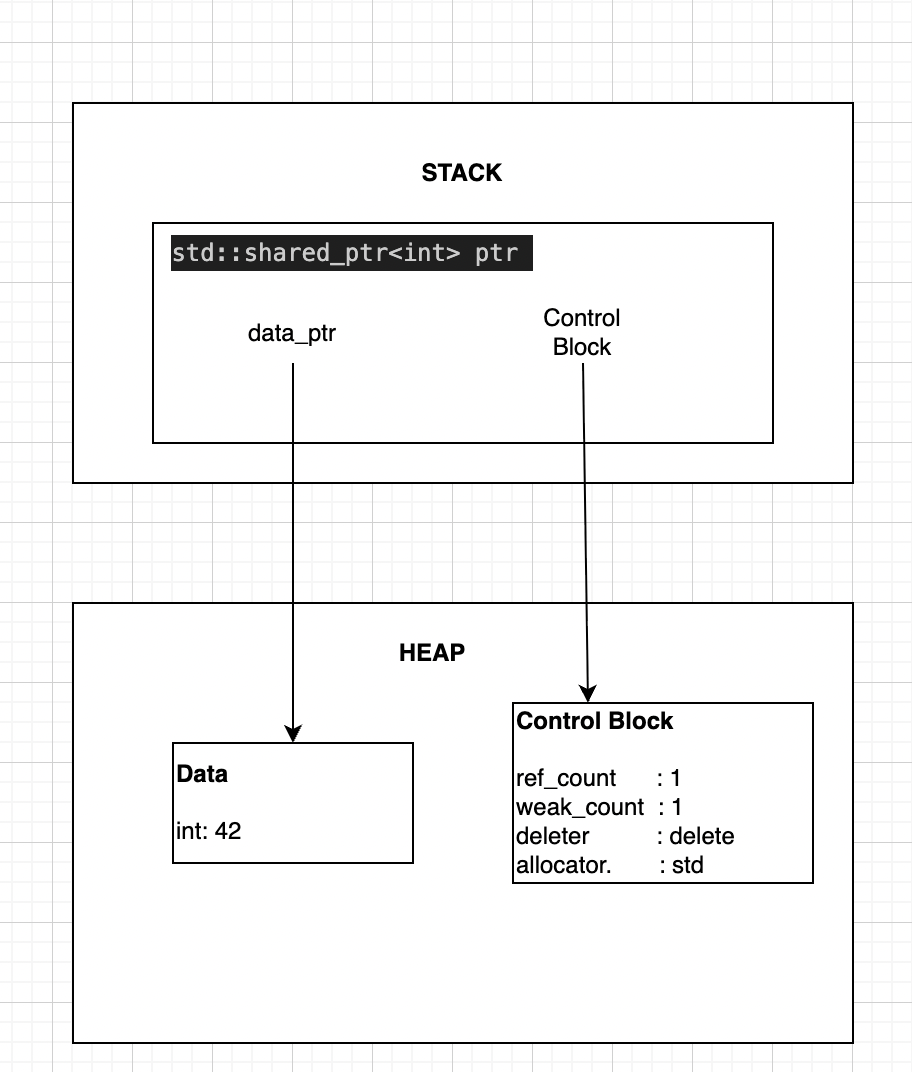
Three shared_ptr Sharing Same Resource
When you do:
std::shared_ptr<int> ptr1 = std::make_shared<int>(42);
std::shared_ptr<int> ptr2 = ptr1;  // Copy
std::shared_ptr<int> ptr3 = ptr1;  // Copy
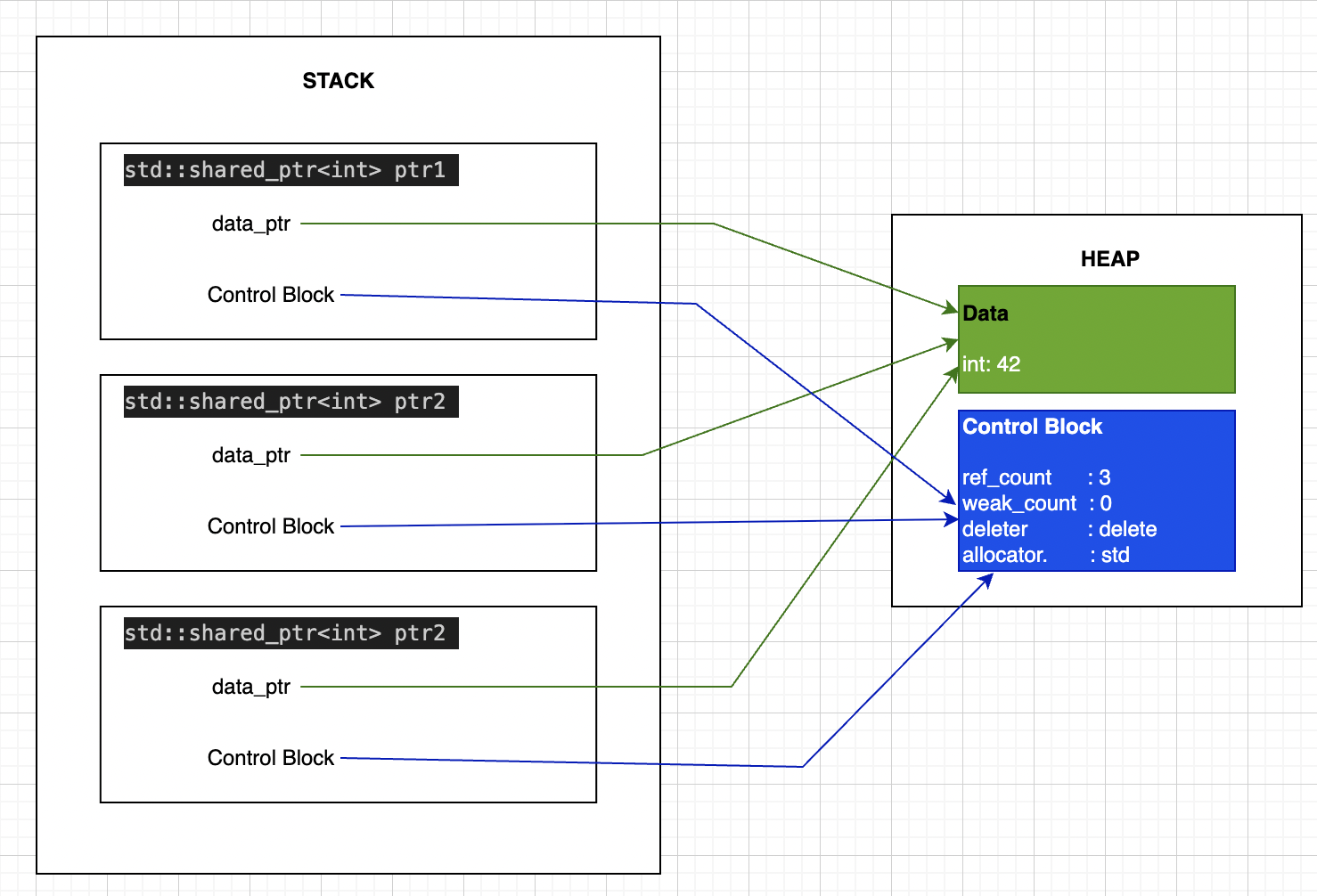
Key Point: All 3 shared_ptr point to the SAME Control Block!
- When ANY one is copied, ref_count increments
- When ANY one is destroyed, ref_count decrements
Creating a shared_ptr
Method 1: Using std::make_shared<T> (Recommended)
std::make_shared<T> is the preferred way to create a shared_ptr. It allocates the object and the reference count metadata in a single operation, making it more efficient. (See the detailed comparison with new in the “Advanced Topics” section at the end.)
#include <memory>
#include <iostream>

class Logger {
public:
    Logger(const std::string& name) : name_(name) {
        std::cout << "Logger '" << name_ << "' created\n";
    }
    ~Logger() {
        std::cout << "Logger '" << name_ << "' destroyed\n";
    }
    void log(const std::string& msg) const {
        std::cout << "[" << name_ << "] " << msg << "\n";
    }
private:
    std::string name_;
};

int main() {
    // Create using make_shared - THIS IS PREFERRED
    std::shared_ptr<Logger> logger1 = std::make_shared<Logger>("Main");

    std::cout << "Reference count: " << logger1.use_count() << "\n";

    logger1->log("Application started");

    return 0;
}

// Output:
// Logger 'Main' created
// Reference count: 1
// [Main] Application started
// Logger 'Main' destroyed
Method 2: Using new (When Custom Deleter Needed)
You can create a shared_ptr by passing a raw pointer, but this should only be used when you need a custom deleter or when make_shared cannot be used. See the “Advanced Topics: new vs make_shared” section at the end for a detailed comparison.
#include <memory>
#include <iostream>

class Resource {
public:
    Resource() { std::cout << "Resource created\n"; }
    ~Resource() { std::cout << "Resource destroyed\n"; }
};

int main() {
    // Create using new - works but less efficient than make_shared
    std::shared_ptr<Resource> res(new Resource());

    return 0;
}

// Output:
// Resource created
// Resource destroyed
Method 3: Converting from unique_ptr
You can move a unique_ptr into a shared_ptr, which transfers ownership:
#include <memory>
#include <iostream>

class Data {
public:
    Data() { std::cout << "Data created\n"; }
    ~Data() { std::cout << "Data destroyed\n"; }
};

int main() {
    std::unique_ptr<Data> uptr = std::make_unique<Data>();

    // Move unique_ptr to shared_ptr
    std::shared_ptr<Data> sptr = std::move(uptr);

    // uptr is now empty, sptr owns the resource
    return 0;
}

// Output:
// Data created
// Data destroyed
Custom Deleters with shared_ptr
Sometimes you need to manage resources that aren’t simple heap-allocated objects. For example, file handles, database connections, or C-style resources that need special cleanup. This is where custom deleters come in.
Why Custom Deleters?
Custom deleters are useful when:
- Managing non-memory resources (files, sockets, handles)
- Working with C APIs that have their own cleanup functions
- Implementing special cleanup logic
- Managing arrays allocated with
new[] - Releasing resources that don’t use
delete
Creating shared_ptr with Custom Deleter
Note: You cannot use make_shared with custom deleters. You must use the shared_ptr constructor with new.
std::shared_ptr<T> ptr(new T(), custom_deleter);
Consider this Example of Managing FILE with Custom Deleter
#include <memory>
#include <iostream>
#include <cstdio>

int main() {
    // Custom deleter for FILE*
    auto fileDeleter = [](FILE* file) {
        if (file) {
            std::cout << "Closing file\n";
            std::fclose(file);
        }
    };

    // Create shared_ptr with custom deleter
    std::shared_ptr<FILE> file(
        std::fopen("data.txt", "w"),
        fileDeleter
    );

    if (file) {
        std::fprintf(file.get(), "Hello, World!\n");
        std::cout << "Data written to file\n";
    }

    return 0;
}

// Output:
// Data written to file
// Closing file
Managing Arrays with delete[]
When you allocate an array with new[], you need to delete it with delete[], not delete. A custom deleter ensures proper cleanup:
#include <memory>
#include <iostream>

int main() {
    // Custom deleter for array
    auto arrayDeleter = [](int* arr) {
        std::cout << "Deleting array with delete[]\n";
        delete[] arr;
    };

    // Create array with custom deleter
    std::shared_ptr<int> arr(
        new int[5]{10, 20, 30, 40, 50},
        arrayDeleter
    );

    // Access array elements
    for (int i = 0; i < 5; ++i) {
        std::cout << "arr[" << i << "] = " << arr.get()[i] << "\n";
    }

    return 0;
}

// Output:
// arr[0] = 10
// arr[1] = 20
// arr[2] = 30
// arr[3] = 40
// arr[4] = 50
// Deleting array with delete[]
Better Alternative: Use shared_ptr<T[]> (C++17+) which automatically uses delete[]:
#include <memory>
#include <iostream>

int main() {
    // C++17: shared_ptr for arrays - no custom deleter needed!
    std::shared_ptr<int[]> arr(new int[5]{10, 20, 30, 40, 50});

    // Can use array subscript operator
    for (int i = 0; i < 5; ++i) {
        std::cout << "arr[" << i << "] = " << arr[i] << "\n";
    }

    return 0;
}
No-Op Deleter (Stack Objects)
Sometimes you want to use shared_ptr with objects you don’t own (like stack-allocated objects). You need a no-op deleter:
#include <memory>
#include <iostream>

class Service {
public:
    Service(int id) : id_(id) {
        std::cout << "Service " << id_ << " created\n";
    }
    ~Service() {
        std::cout << "Service " << id_ << " destroyed\n";
    }
    void process() {
        std::cout << "Processing with service " << id_ << "\n";
    }
private:
    int id_;
};

void useService(std::shared_ptr<Service> service) {
    service->process();
}

int main() {
    Service stackService(1);

    // No-op deleter - don't delete stack object
    auto noopDeleter = [](Service*) {
        std::cout << "(No-op deleter called)\n";
    };

    std::shared_ptr<Service> servicePtr(&stackService, noopDeleter);

    useService(servicePtr);

    return 0;
}

// Output:
// Service 1 created
// Processing with service 1
// (No-op deleter called)
// Service 1 destroyed
Custom Deleter Syntax Summary
// Lambda deleter
std::shared_ptr<T> ptr(new T(), [](T* p) { delete p; });

// Function pointer deleter
void customDelete(T* p) { delete p; }
std::shared_ptr<T> ptr(new T(), customDelete);

// Functor deleter
struct Deleter {
    void operator()(T* p) const { delete p; }
};
std::shared_ptr<T> ptr(new T(), Deleter{});

// std::function deleter
std::function<void(T*)> deleter = [](T* p) { delete p; };
std::shared_ptr<T> ptr(new T(), deleter);
Some situation where usage of Custom Deleters is needed
| Situation | Use Custom Deleter |
|---|---|
| Standard heap allocation | Use make_shared |
| Arrays | Use shared_ptr<T[]> (C++17+) or custom deleter |
| C API resources | Custom deleter with C cleanup function |
| File handles | Custom deleter with fclose |
| Special cleanup logic | Custom deleter |
| Stack objects | No-op deleter |
| Logging/debugging | Custom deleter with logging |
Important Notes About Custom Deleters
- Cannot use make_shared: Custom deleters require constructor syntax
- Two allocations: Unlike
make_shared, this creates two separate allocations - Type erasure: The deleter type is stored in the control block
- Shared among copies: All copies of the shared_ptr share the same deleter
- Called once: The deleter is only called when ref_count reaches 0
Copying and Sharing Ownership
The key feature of shared_ptr is that you can freely copy it, and each copy increases the reference count.
#include <memory>
#include <iostream>

class Service {
public:
    Service(const std::string& name) : name_(name) {
        std::cout << "Service '" << name_ << "' started\n";
    }
    ~Service() {
        std::cout << "Service '" << name_ << "' stopped\n";
    }
    void process() const {
        std::cout << "Processing...\n";
    }
private:
    std::string name_;
};

int main() {
    std::shared_ptr<Service> service = std::make_shared<Service>("DataProcessor");

    std::cout << "Count after creation: " << service.use_count() << "\n";

    // Copy the pointer - count increments
    std::shared_ptr<Service> service_copy1 = service;
    std::cout << "Count after 1st copy: " << service.use_count() << "\n";

    std::shared_ptr<Service> service_copy2 = service;
    std::cout << "Count after 2nd copy: " << service.use_count() << "\n";

    service_copy1->process();

    {
        std::shared_ptr<Service> service_copy3 = service;
        std::cout << "Count inside scope: " << service.use_count() << "\n";
    }
    // service_copy3 goes out of scope - count decrements to 3

    std::cout << "Count after scope: " << service.use_count() << "\n";

    return 0;
}

// Output:
// Service 'DataProcessor' started
// Count after creation: 1
// Count after 1st copy: 2
// Count after 2nd copy: 3
// Processing...
// Count inside scope: 4
// Count after scope: 3
// Service 'DataProcessor' stopped
Checking Ownership Information
use_count() - How Many Owners?
#include <memory>
#include <iostream>

int main() {
    std::shared_ptr<int> ptr1 = std::make_shared<int>(100);

    std::cout << "Owners: " << ptr1.use_count() << "\n";  // Prints: 1

    std::shared_ptr<int> ptr2 = ptr1;
    std::cout << "Owners: " << ptr1.use_count() << "\n";  // Prints: 2

    std::shared_ptr<int> ptr3 = ptr1;
    std::cout << "Owners: " << ptr1.use_count() << "\n";  // Prints: 3

    return 0;
}
unique() - Am I the Only Owner?
#include <memory>
#include <iostream>

int main() {
    std::shared_ptr<int> ptr1 = std::make_shared<int>(50);

    if (ptr1.unique()) {
        std::cout << "I'm the only owner\n";  // This prints
    }

    std::shared_ptr<int> ptr2 = ptr1;

    if (!ptr1.unique()) {
        std::cout << "Multiple owners exist\n";  // This prints
    }

    return 0;
}
bool Conversion - Is It Valid?
#include <memory>
#include <iostream>

int main() {
    std::shared_ptr<int> ptr;

    if (!ptr) {
        std::cout << "ptr is empty\n";  // Prints
    }

    ptr = std::make_shared<int>(42);

    if (ptr) {
        std::cout << "ptr is valid\n";  // Prints
    }

    return 0;
}
The get() Method
What Does get() Do?
The get() method returns a raw pointer to the managed resource without transferring ownership. The shared_ptr retains ownership and will delete the resource when all owners are destroyed.
T* get() const noexcept;
Returns: Raw pointer to the managed object, or nullptr if empty
Use Case 1: Passing to Legacy C APIs
#include <memory>
#include <cstdio>
#include <cstring>

void legacyPrintString(const char* str) {
    std::printf("String: %s\n", str);
}

int main() {
    std::shared_ptr<char[]> buffer = std::make_shared<char[]>(100);

    std::strcpy(buffer.get(), "Hello, World!");
    legacyPrintString(buffer.get());

    return 0;
}

// Output:
// String: Hello, World!
Use Case 2: Null Check Before Use
#include <memory>
#include <iostream>

class Service {
public:
    void process() { std::cout << "Processing...\n"; }
};

int main() {
    std::shared_ptr<Service> service;

    if (service.get() != nullptr) {
        service->process();
    } else {
        std::cout << "Service not initialized\n";
    }

    return 0;
}

// Output:
// Service not initialized
Dangers of get()
DANGER: Don’t store the pointer beyond the scope where shared_ptr is valid
#include <memory>
#include <iostream>

class Resource {
public:
    ~Resource() { std::cout << "Resource destroyed\n"; }
};

int main() {
    Resource* dangling = nullptr;

    {
        std::shared_ptr<Resource> res = std::make_shared<Resource>();
        dangling = res.get();  // OK here
    }  // res destroyed here

    // DANGER: dangling points to freed memory!
    // dangling->doWork();  // UNDEFINED BEHAVIOR

    return 0;
}
The reset() Method
What Does reset() Do?
The reset() method releases the shared_ptr’s ownership of its current resource and optionally takes ownership of a new one. The reference count is decremented, and if it reaches zero, the resource is deleted.
void reset() noexcept;
void reset(T* ptr) noexcept;
Use Case 1: Explicitly Release a Resource
#include <memory>
#include <iostream>

class Connection {
public:
    Connection(const std::string& host) : host_(host) {
        std::cout << "Connecting to " << host_ << "\n";
    }
    ~Connection() {
        std::cout << "Disconnecting from " << host_ << "\n";
    }
private:
    std::string host_;
};

int main() {
    std::shared_ptr<Connection> conn = std::make_shared<Connection>("localhost");

    std::cout << "Connection active. Count: " << conn.use_count() << "\n";

    conn.reset();

    std::cout << "After reset. Count: " << conn.use_count() << "\n";

    return 0;
}

// Output:
// Connecting to localhost
// Connection active. Count: 1
// Disconnecting from localhost
// After reset. Count: 0
Use Case 2: Replace One Resource with Another
#include <memory>
#include <iostream>

class File {
public:
    File(const std::string& name) : name_(name) {
        std::cout << "Opening: " << name_ << "\n";
    }
    ~File() {
        std::cout << "Closing: " << name_ << "\n";
    }
private:
    std::string name_;
};

int main() {
    std::shared_ptr<File> file = std::make_shared<File>("data.txt");

    std::cout << "Switching files...\n";

    file.reset(new File("log.txt"));

    return 0;
}

// Output:
// Opening: data.txt
// Switching files...
// Closing: data.txt
// Opening: log.txt
// Closing: log.txt
Use Case 3: Shared Ownership - reset() Only Affects One Owner
#include <memory>
#include <iostream>

class Data {
public:
    Data(int val) : val_(val) {
        std::cout << "Data(" << val_ << ") created\n";
    }
    ~Data() {
        std::cout << "Data(" << val_ << ") destroyed\n";
    }
private:
    int val_;
};

int main() {
    std::shared_ptr<Data> ptr1 = std::make_shared<Data>(42);
    std::shared_ptr<Data> ptr2 = ptr1;  // Share ownership

    std::cout << "Count before reset: " << ptr1.use_count() << "\n";

    ptr2.reset();  // ptr2 releases its ownership

    std::cout << "Count after reset: " << ptr1.use_count() << "\n";
    std::cout << "ptr1 still valid: " << (ptr1.get() != nullptr) << "\n";

    return 0;
}

// Output:
// Data(42) created
// Count before reset: 2
// Count after reset: 1
// ptr1 still valid: 1
// Data(42) destroyed
Comparison: get() vs reset()
| Aspect | get() | reset() |
|---|---|---|
| Purpose | Borrow raw pointer | Release ownership |
| Ownership Change | No | Yes - decrements ref count |
| Pointer Valid After | If shared_ptr alive | After reset call |
| Side Effects | None | May delete resource |
| Use Case | Legacy APIs, temporary access | Cleanup, replacement |
std::weak_ptr: Non-Owning Observer
Introduction: The Circular Reference Problem
Before diving into weak_ptr, let’s understand the problem it solves. Consider this scenario:
class Node {
public:
    std::shared_ptr<Node> next;
    std::shared_ptr<Node> prev;
};

int main() {
    auto node1 = std::make_shared<Node>();
    auto node2 = std::make_shared<Node>();

    node1->next = node2;  // node1 → node2
    node2->prev = node1;  // node2 → node1

    // MEMORY LEAK!
    // node1 keeps node2 alive
    // node2 keeps node1 alive
    // Neither can be deleted!

    return 0;
}
The Problem:
node1has ashared_ptrtonode2→ ref_count(node2) = 1node2has ashared_ptrtonode1→ ref_count(node1) = 1- When
node1goes out of scope, it can’t be deleted (ref_count = 1) - When
node2goes out of scope, it can’t be deleted (ref_count = 1) - Result: Both nodes leak memory!
This is called a circular reference or reference cycle.
What is std::weak_ptr?
std::weak_ptr<T> is a smart pointer that holds a non-owning reference to an object managed by shared_ptr. It does not affect the reference count and cannot directly access the object.
Key Characteristics
- Non-owning: Does not contribute to reference counting
- No Direct Access: Cannot use
*or->operators directly - Must be converted: Use
lock()to get ashared_ptrfor access - Can detect expiration: Use
expired()to check if object still exists - Breaks circular references: Solves the circular dependency problem
- Lightweight: Only stores a pointer to the control block
How weak_ptr Works
#include <memory>
#include <iostream>

int main() {
    std::weak_ptr<int> weak;

    {
        std::shared_ptr<int> shared = std::make_shared<int>(42);
        std::cout << "shared ref_count: " << shared.use_count() << "\n";  // 1

        weak = shared;  // weak_ptr created
        std::cout << "shared ref_count: " << shared.use_count() << "\n";  // Still 1!

        // weak_ptr does NOT increment ref_count
    }

    // shared destroyed, object deleted
    std::cout << "Object expired: " << weak.expired() << "\n";  // true

    return 0;
}

// Output:
// shared ref_count: 1
// shared ref_count: 1
// Object expired: 1
Key Insight: weak_ptr observes but doesn’t own!
The Control Block with weak_ptr
Remember the control block structure? It has TWO counters:
Control Block:
┌──────────────────┐
│ shared_count: 2  │ ◄── Number of shared_ptr owners
│ weak_count: 3    │ ◄── Number of weak_ptr observers
│ deleter          │
│ allocator        │
└──────────────────┘
Important Rules:
- Object is deleted when
shared_countreaches 0 - Control block is deleted when
weak_countreaches 0 weak_ptrincrementsweak_count, notshared_count
Creating a weak_ptr
You cannot create a weak_ptr directly. It must be created from a shared_ptr:
#include <memory>

int main() {
    // Cannot create weak_ptr from nothing
    // std::weak_ptr<int> weak;  // This creates an empty weak_ptr

    // Create from shared_ptr
    std::shared_ptr<int> shared = std::make_shared<int>(100);
    std::weak_ptr<int> weak = shared;

    // Copy from another weak_ptr
    std::weak_ptr<int> weak2 = weak;

    return 0;
}
Using weak_ptr: The lock() Method
To access the object through a weak_ptr, you must convert it to a shared_ptr using lock():
std::shared_ptr<T> lock() const noexcept;
Returns:
- A
shared_ptrto the object if it still exists - An empty
shared_ptrif the object has been deleted
Why lock()?
- Thread-safe: Atomically checks existence and creates
shared_ptr - Safe access: Ensures object stays alive during use
- Prevents race conditions: Object can’t be deleted while you’re using it
#include <memory>
#include <iostream>

int main() {
    std::weak_ptr<int> weak;

    {
        std::shared_ptr<int> shared = std::make_shared<int>(42);
        weak = shared;

        // Convert weak_ptr to shared_ptr
        if (auto locked = weak.lock()) {
            std::cout << "Value: " << *locked << "\n";  // Safe to use
            std::cout << "Ref count: " << locked.use_count() << "\n";  // 2
        }

        std::cout << "shared ref count: " << shared.use_count() << "\n";  // Back to 1
    }

    // Object deleted here

    // Try to access deleted object
    if (auto locked = weak.lock()) {
        std::cout << "Still exists\n";
    } else {
        std::cout << "Object has been deleted\n";  // This prints
    }

    return 0;
}

// Output:
// Value: 42
// Ref count: 2
// shared ref count: 1
// Object has been deleted
Checking if Object Exists: expired()
bool expired() const noexcept;
Returns:
trueif the object has been deleted (shared_count = 0)falseif the object still exists
#include <memory>
#include <iostream>

int main() {
    std::weak_ptr<int> weak;

    {
        std::shared_ptr<int> shared = std::make_shared<int>(99);
        weak = shared;

        std::cout << "expired: " << weak.expired() << "\n";  // false
    }

    std::cout << "expired: " << weak.expired() << "\n";  // true

    return 0;
}

// Output:
// expired: 0
// expired: 1
Important: expired() can have a race condition in multithreaded code. Prefer using lock() instead:
// Race condition possible
if (!weak.expired()) {
    auto shared = weak.lock();  // Object might be deleted here!
}

// Thread-safe
if (auto shared = weak.lock()) {
    // Object guaranteed to exist here
}
Getting the Reference Count: use_count()
long use_count() const noexcept;
Returns: The number of shared_ptr instances owning the object (0 if expired)
#include <memory>
#include <iostream>

int main() {
    auto shared1 = std::make_shared<int>(42);
    std::weak_ptr<int> weak = shared1;

    std::cout << "Count: " << weak.use_count() << "\n";  // 1

    auto shared2 = shared1;
    std::cout << "Count: " << weak.use_count() << "\n";  // 2

    shared1.reset();
    std::cout << "Count: " << weak.use_count() << "\n";  // 1

    shared2.reset();
    std::cout << "Count: " << weak.use_count() << "\n";  // 0

    return 0;
}

// Output:
// Count: 1
// Count: 2
// Count: 1
// Count: 0
Solving Circular References with weak_ptr
Let’s fix the circular reference problem from the introduction:
#include <memory>
#include <iostream>
#include <string>

class Node {
public:
    std::string data;
    std::shared_ptr<Node> next;  // Owning reference
    std::weak_ptr<Node> prev;    // Non-owning reference

    Node(const std::string& d) : data(d) {
        std::cout << "Node '" << data << "' created\n";
    }

    ~Node() {
        std::cout << "Node '" << data << "' destroyed\n";
    }
};

int main() {
    auto node1 = std::make_shared<Node>("First");
    auto node2 = std::make_shared<Node>("Second");

    node1->next = node2;  // node1 owns node2
    node2->prev = node1;  // node2 observes node1 (non-owning)

    std::cout << "node1 ref_count: " << node1.use_count() << "\n";  // 1
    std::cout << "node2 ref_count: " << node2.use_count() << "\n";  // 2

    // Access prev through weak_ptr
    if (auto prevNode = node2->prev.lock()) {
        std::cout << "node2's prev: " << prevNode->data << "\n";
    }

    return 0;
}

// Output:
// Node 'First' created
// Node 'Second' created
// node1 ref_count: 1
// node2 ref_count: 2
// node2's prev: First
// Node 'Second' destroyed  - No leak!
// Node 'First' destroyed   - No leak!
Why it works:
node1 → node2(shared_ptr) → node2’s ref_count = 2node2 → node1(weak_ptr) → node1’s ref_count stays = 1- When
node1goes out of scope → ref_count = 0 → deleted - When
node2goes out of scope → ref_count = 1, then 0 → deleted - No circular reference, proper cleanup!
weak_ptr Member Functions Summary
| Function | Purpose | Returns |
|---|---|---|
lock() | Get shared_ptr if object exists | shared_ptr<T> (or empty) |
expired() | Check if object deleted | bool |
use_count() | Get number of shared_ptr owners | long |
reset() | Release the weak reference | void |
swap(other) | Swap with another weak_ptr | void |
Common Patterns and Best Practices
Pattern 1: Always Use lock() for Access
// Correct
std::weak_ptr<Data> weak = shared;

if (auto locked = weak.lock()) {
    locked->process();  // Safe
}

// Wrong - race condition
if (!weak.expired()) {
    auto locked = weak.lock();  // Object might be deleted here!
    locked->process();
}
Pattern 2: Check Both Expiration and Validity
std::weak_ptr<Resource> weak = shared;

// When you need to distinguish between "expired" and "null"
if (auto locked = weak.lock()) {
    if (locked) {  // Additional null check
        locked->use();
    }
} else {
    // Object has been deleted or weak_ptr was never initialized
}
Pattern 3: Cleanup Expired weak_ptr from Containers
std::vector<std::weak_ptr<Observer>> observers;

// Remove expired observers periodically
void cleanupExpired() {
    observers.erase(
        std::remove_if(observers.begin(), observers.end(),
            [](const std::weak_ptr<Observer>& weak) {
                return weak.expired();
            }),
        observers.end()
    );
}
Pattern 4: Convert weak_ptr to shared_ptr Temporarily
class Service {
    std::weak_ptr<Resource> resource_;
public:
    void process() {
        // Lock only for the duration of use
        if (auto res = resource_.lock()) {
            res->doWork();
        }  // shared_ptr destroyed, ref_count decremented
    }
};
Performance Considerations
Memory Overhead
std::weak_ptr<int> weak; // 16 bytes (two pointers)
Components:
- Pointer to control block: 8 bytes
- Pointer to object (for lock()): 8 bytes
Control block impact:
- Increments
weak_count(notshared_count) - Control block stays alive until
weak_count = 0 - Object can be deleted while control block persists
lock() Performance
auto shared = weak.lock(); // Atomic operation
Cost:
- Atomic load/increment of
shared_count - Check if count > 0
- ~10-20 CPU cycles
Recommendation: Don’t call lock() repeatedly in tight loops:
// Inefficient
for (int i = 0; i < 1000; ++i) {
    if (auto obj = weak.lock()) {
        obj->process(i);
    }
}

// Better
if (auto obj = weak.lock()) {
    for (int i = 0; i < 1000; ++i) {
        obj->process(i);
    }
}
Common Pitfalls
Pitfall 1: Forgetting to lock()
// Won't compile
std::weak_ptr<int> weak = shared;
*weak = 42;  // ERROR: weak_ptr has no operator*

// Correct
if (auto locked = weak.lock()) {
    *locked = 42;
}
Pitfall 2: Dangling weak_ptr in Multithreaded Code
// Thread-unsafe
std::weak_ptr<Data> weak = shared;

// Thread 1
if (!weak.expired()) {
    // Thread 2 might delete object here!
    auto obj = weak.lock();  // Might fail
}

// Thread-safe
if (auto obj = weak.lock()) {
    // Object guaranteed alive here
}
Pitfall 3: Creating weak_ptr from this
class Widget {
public:
    void registerSelf() {
        // Won't compile
        // std::weak_ptr<Widget> weak(this);

        // Use enable_shared_from_this
    }
};
Use std::enable_shared_from_this instead (covered in parent documentation).
When to Use weak_ptr
| Situation | Use |
|---|---|
| Breaking circular references | weak_ptr |
| Observer pattern | weak_ptr |
| Cache implementations | weak_ptr |
| Parent-child relationships | weak_ptr (child → parent) |
| Back-references in graphs | weak_ptr |
| Callbacks without ownership | weak_ptr |
| Temporary non-owning access | Raw pointer or reference |
| Ownership required | shared_ptr |
Comparison: shared_ptr vs weak_ptr
| Aspect | shared_ptr | weak_ptr |
|---|---|---|
| Ownership | Owns the object | Observes the object |
| Reference Count | Increments shared_count | Increments weak_count |
| Direct Access | Yes (*, ->) | No (must lock()) |
| Keeps Object Alive | Yes | No |
| Can Create From | make_shared, new, unique_ptr | Only from shared_ptr |
| Use Case | Ownership | Observation, breaking cycles |
weak_ptr Summary
Core Concepts:
- Non-owning observer of
shared_ptr-managed objects - Does not affect object lifetime (doesn’t increment
shared_count) - Must use
lock()to access the object safely - Automatically detects when object is deleted
Key Methods:
lock(): Get temporaryshared_ptrfor safe accessexpired(): Check if object has been deleteduse_count(): Get number ofshared_ptrowners
Primary Use Cases:
- Breaking circular references
- Observer pattern implementations
- Cache with automatic cleanup
- Parent-child relationships (child observes parent)
- Graph structures with cycles
Best Practices:
- Always use
lock()for access, neverexpired()+lock() - Clean up expired
weak_ptrfrom containers periodically - Use for back-references to prevent cycles
- Avoid storing raw pointers from
lock()
weak_ptr is essential for managing complex object relationships while avoiding memory leaks from circular references!
The Problem: new vs make_shared
Memory Layout with new
Code: std::shared_ptr<int> ptr(new int(42));
Step 1: new int(42) allocates data

┌──────────────────────┐
│    HEAP MEMORY       │
│  ┌────────────────┐  │
│  │ int: 42        │  │ ◄── Allocation 1 (for data)
│  │                │  │
│  └────────────────┘  │
│                      │
│  (fragmented space)  │
│                      │
│  ┌────────────────┐  │
│  │ Control Block  │  │ ◄── Allocation 2 (for control block)
│  │ ref_count: 1   │  │
│  │ weak_count: 0  │  │
│  │ deleter        │  │
│  │ allocator      │  │
│  └────────────────┘  │
└──────────────────────┘
Problems:
-
Non-contiguous Memory: Data and Control Block are in separate heap locations
- CPU cache misses increase
- Performance is degraded
-
Exception Safety Risk: If shared_ptr constructor fails after new succeeds
- Memory for data is allocated but not managed
- Result: MEMORY LEAK
Example of Memory Leak (C++14 and earlier):
Note: This issue was fixed in C++17 where function argument evaluation order was made deterministic. However, understanding this problem helps explain why make_shared is still preferred.
void processData(std::shared_ptr<Data> d1, std::shared_ptr<Data> d2);

processData(
    std::shared_ptr<Data>(new Data()),  // Allocation 1
    std::shared_ptr<Data>(new Data())   // Allocation 2
);
In C++14 and earlier, the compiler could execute in this order:
new Data()◄── Successnew Data()◄── Exception thrown here!- Allocate control block ◄── Never reached
- Allocate control block ◄── Never reached
Result: First Data() allocated but not wrapped in shared_ptr → MEMORY LEAK
In C++17+: Arguments are evaluated in a more predictable order, preventing this specific leak. However, make_shared is still superior for performance and remains the recommended approach.
Memory Layout with make_shared
Code: std::shared_ptr<int> ptr = std::make_shared<int>(42);
Single Allocation: Both data and control block together

┌─────────────────────────────────────────┐
│           HEAP MEMORY                   │
│   ┌───────────────────────────────────┐ │
│   │   Single Contiguous Block         │ │ ◄── Allocation 1 (both together)
│   │                                   │ │
│   │  ┌──────────────────┐             │ │
│   │  │ Control Block    │             │ │
│   │  │ ref_count: 1     │             │ │
│   │  │ weak_count: 0    │             │ │
│   │  │ deleter          │             │ │
│   │  │ allocator        │             │ │
│   │  └──────────────────┘             │ │
│   │                                   │ │
│   │  ┌──────────────────┐             │ │
│   │  │ int: 42          │             │ │
│   │  │                  │             │ │
│   │  └──────────────────┘             │ │
│   │                                   │ │
│   └───────────────────────────────────┘ │
│                                         │
│   CONTIGUOUS MEMORY                     │
│   ATOMIC OPERATION                      │
│   EXCEPTION SAFE                        │
└─────────────────────────────────────────┘
Why make_shared is Better:
ADVANTAGE 1: Single Allocation
- Data and control block allocated together
- Contiguous memory layout
- Better CPU cache locality
- Fewer system calls
ADVANTAGE 2: Exception Safety
- Either entire operation succeeds OR fails
- No intermediate states where memory can leak
- Atomic from shared_ptr perspective
ADVANTAGE 3: Performance
- Only ONE system allocation
- Better memory layout for CPU cache
- Less memory overhead
Example of Safe Exception Handling:
void processData(std::shared_ptr<Data> d1, std::shared_ptr<Data> d2);

processData(
    std::make_shared<Data>(),  // If fails, nothing allocated
    std::make_shared<Data>()   // If fails, first is cleaned up
);
Each make_shared is atomic:
- Success: Data AND control block allocated + wrapped
- Failure: Exception thrown, nothing allocated, no leak
Comparison Table: new vs make_shared
| Characteristic | new | make_shared |
|---|---|---|
| Memory Allocations | 2 allocations (fragmented) | 1 allocation (contiguous) |
| Cache Efficiency | Poor (separate memory) | Good (same cache line) |
| Exception Safety | Risky (memory leak) | Safe (atomic) |
| Memory Leak Risk | High (if ctor fails) | None (atomic operation) |
| Performance (delete) | Same | Same |
| Custom Deleter | Supported (via 2nd param) | Not supported (use new for custom) |
| Memory with weak_ptr | Object freed when shared count = 0 | Object memory held until weak count = 0 |
| Recommended? | When custom deleter or weak_ptr used heavily | YES, for most cases |
Real-World Impact
Scenario: Creating 1000 shared_ptr objects
Using new:
- 2000 memory allocations
- Fragmented heap
- Many cache misses
- If one fails → potential leaks
Using make_shared:
- 1000 memory allocations
- Contiguous for each object
- Fewer cache misses
- Atomic per object → no leaks
When to Use new Instead of make_shared
While make_shared is generally preferred, there are specific scenarios where using new is actually better:
Scenario 1: Custom Deleters Required
make_shared does not support custom deleters. If you need special cleanup logic, you must use new:
// Cannot use make_shared for custom deleter
std::shared_ptr<FILE> file(
    fopen("data.txt", "r"),
    [](FILE* f) { if (f) fclose(f); }
);
Scenario 2: Heavy Use of weak_ptr (Memory Concern)
This is a subtle but important consideration related to how make_shared allocates memory.
The Problem: Control Block Lifetime with make_shared
When you use make_shared, the object and control block are allocated together in a single memory block. While this is normally efficient, it creates an issue with weak_ptr:
make_shared Memory Layout:
┌─────────────────────────────────────┐
│  Single Contiguous Allocation       │
│                                     │
│  ┌────────────────┐                 │
│  │ Control Block  │                 │
│  │ shared_count   │                 │
│  │ weak_count     │ ◄── weak_ptr keeps this alive
│  └────────────────┘                 │
│                                     │
│  ┌────────────────┐                 │
│  │ Large Object   │                 │
│  │ (e.g., 1 MB)   │ ◄── Cannot free this separately!
│  └────────────────┘                 │
└─────────────────────────────────────┘
Why This Matters:
-
weak_ptr keeps control block alive: A
weak_ptrmust check if the managed object is still valid by looking at the shared_ptr count in the control block -
Control block must stay alive: Even when all
shared_ptrinstances are destroyed (shared_count = 0), if anyweak_ptrexists (weak_count > 0), the control block must remain -
Object memory cannot be freed separately: Since
make_sharedallocates object and control block together, the entire memory block (including the large object) stays allocated until both counts reach zero
Example of the Problem:
#include <memory>
#include <iostream>
#include <vector>

class LargeObject {
    std::vector<int> data_;
public:
    LargeObject() : data_(1'000'000, 42) {  // 4 MB of data
        std::cout << "LargeObject created (4 MB)\n";
    }
    ~LargeObject() {
        std::cout << "LargeObject destroyed\n";
    }
};

int main() {
    std::weak_ptr<LargeObject> weak;

    {
        // Using make_shared
        std::shared_ptr<LargeObject> shared = std::make_shared<LargeObject>();
        weak = shared;

        std::cout << "shared_count: " << weak.use_count() << "\n";
    }

    // shared is destroyed, but...
    std::cout << "After shared destroyed\n";
    std::cout << "shared_count: " << weak.use_count() << "\n";
    std::cout << "weak_count: " << weak.expired() ? 0 : 1 << "\n";

    // PROBLEM: The 4 MB LargeObject memory is STILL ALLOCATED
    // because weak_ptr keeps the control block (and entire allocation) alive!

    std::cout << "4 MB still allocated until weak goes out of scope!\n";

    return 0;
}

// Output:
// LargeObject created (4 MB)
// shared_count: 1
// LargeObject destroyed  ◄── Destructor runs
// After shared destroyed
// shared_count: 0
// weak_count: 1
// 4 MB still allocated until weak goes out of scope!  ◄── Memory not freed!
The Solution: Use new for Separate Allocation
When using new, object and control block are allocated separately:
new + shared_ptr Memory Layout:
┌────────────────┐
│ Control Block  │ ◄── weak_ptr keeps only this alive
│ shared_count   │     (small, ~24-48 bytes)
│ weak_count     │
└────────────────┘

        (separate allocation)

┌────────────────┐
│ Large Object   │ ◄── Can be freed when shared_count = 0
│ (e.g., 1 MB)   │     even if weak_count > 0
└────────────────┘
Example with Separate Allocation:
#include <memory>
#include <iostream>
#include <vector>

class LargeObject {
    std::vector<int> data_;
public:
    LargeObject() : data_(1'000'000, 42) {  // 4 MB of data
        std::cout << "LargeObject created (4 MB)\n";
    }
    ~LargeObject() {
        std::cout << "LargeObject destroyed\n";
    }
};

int main() {
    std::weak_ptr<LargeObject> weak;

    {
        // Using new instead of make_shared
        std::shared_ptr<LargeObject> shared(new LargeObject());
        weak = shared;

        std::cout << "shared_count: " << weak.use_count() << "\n";
    }

    // BETTER: The 4 MB LargeObject memory is freed immediately
    // Only the small control block (~48 bytes) remains

    std::cout << "After shared destroyed\n";
    std::cout << "shared_count: " << weak.use_count() << "\n";
    std::cout << "Only control block (~48 bytes) still allocated\n";

    return 0;
}

// Output:
// LargeObject created (4 MB)
// shared_count: 1
// LargeObject destroyed  ◄── Destructor runs
// After shared destroyed
// shared_count: 0
// Only control block (~48 bytes) still allocated  ◄── Object memory freed!
When to Prefer new Over make_shared:
Use new when:
- The object is large (significant memory footprint)
- You expect
weak_ptrinstances to outlive allshared_ptrinstances - You want the object’s memory freed immediately when the last
shared_ptris destroyed
Memory Timeline Comparison:
// With make_shared:
auto shared = std::make_shared<LargeObject>();  // Allocate: control block + object (single block)
weak_ptr<LargeObject> weak = shared;
shared.reset();  // Object destroyed but memory NOT freed (weak_ptr keeps it)
weak.reset();    // NOW entire memory freed

// With new:
auto shared = std::shared_ptr<LargeObject>(new LargeObject());  // Allocate: control block, object (separate)
weak_ptr<LargeObject> weak = shared;
shared.reset();  // Object destroyed AND object memory freed immediately
weak.reset();    // Control block freed (only ~48 bytes)
Scenario: Large object (1 MB) with weak_ptr that outlives shared_ptr

make_shared approach:
  All shared_ptr destroyed → Object destructor runs
  └─> BUT: 1 MB + control block still allocated

  All weak_ptr destroyed → NOW 1 MB freed
  └─> Total time holding 1 MB: Entire weak_ptr lifetime

new approach:
  All shared_ptr destroyed → Object destructor runs AND 1 MB freed
  └─> Only ~48 byte control block remains

  All weak_ptr destroyed → Control block freed
  └─> Total time holding 1 MB: Only shared_ptr lifetime
Trade-off Summary:
| Aspect | make_shared | new |
|---|---|---|
| Allocations | 1 (faster) | 2 (slower) |
| Cache locality | Better | Worse |
| Exception safety | Better | Worse (pre-C++17) |
| Object memory freed | When weak_count = 0 | When shared_count = 0 |
| Best for | Normal usage, short-lived weak_ptr | Large objects, long-lived weak_ptr |
Recommendation:
- Default to
make_sharedfor most cases - Use
newwhen:- You need custom deleters
- Object is large (> 1 KB) AND
- weak_ptr instances may significantly outlive shared_ptr instances
Best Practices for shared_ptr
1. Always Use std::make_shared<T>
Preferred:
auto ptr = std::make_shared<Resource>();
Avoid (unless custom deleter needed):
std::shared_ptr<Resource> ptr(new Resource());
Why?
- Single allocation (better performance)
- Exception safe
- Better cache locality
2. Pass by const Reference When Not Taking Ownership
Efficient:
void process(const std::shared_ptr<Data>& data) {
    // Use data without modifying shared_ptr
    data->doWork();
}
Inefficient:
void process(std::shared_ptr<Data> data) {
    // Unnecessary copy, increments/decrements ref count
    data->doWork();
}
3. Pass by Value Only When Taking Shared Ownership
class Container {
public:
    void store(std::shared_ptr<Data> data) {
        // Function takes shared ownership
        storage_.push_back(data);
    }
private:
    std::vector<std::shared_ptr<Data>> storage_;
};
4. Avoid Storing Raw Pointers from get()
Dangerous:
Data* rawPtr = sharedPtr.get();
// Later... sharedPtr might be destroyed
rawPtr->doWork();  // Potential use-after-free
Safe:
std::shared_ptr<Data> copy = sharedPtr;
// Now copy keeps the resource alive
copy->doWork();  // Safe
5. Don’t Mix Ownership Models
Consistent - Good:
std::shared_ptr<Database> db = std::make_shared<Database>();
std::shared_ptr<Session> session = std::make_shared<Session>(db);
Inconsistent - Confusing:
Database* db = new Database();  // Raw pointer
std::shared_ptr<Session> session = std::make_shared<Session>(db);
// Who owns db? Unclear!
6. Be Careful with this Pointer
Problem:
class Widget {
public:
    void registerCallback() {
        // Creates separate shared_ptr from raw this
        callback_system.setCallback(std::shared_ptr<Widget>(this));
        // This will double-delete!
    }
};
Solution: Use enable_shared_from_this
class Widget : public std::enable_shared_from_this<Widget> {
public:
    void registerCallback() {
        // Safely creates shared_ptr from this
        callback_system.setCallback(shared_from_this());
    }
};

// Usage:
auto widget = std::make_shared<Widget>();
widget->registerCallback();  // Safe!
7. Use Custom Deleters for Non-Memory Resources
// For C resources
auto fileDeleter = [](FILE* f) {
    if (f) fclose(f);
};
std::shared_ptr<FILE> file(fopen("data.txt", "r"), fileDeleter);

// For C++ arrays (or use shared_ptr<T[]> in C++17+)
auto arrayDeleter = [](int* arr) {
    delete[] arr;
};
std::shared_ptr<int> arr(new int[100], arrayDeleter);
Common Pitfalls and Solutions
Pitfall 1: Creating Multiple Control Blocks
Problem:
Widget* raw = new Widget();
std::shared_ptr<Widget> ptr1(raw);
std::shared_ptr<Widget> ptr2(raw);  // Second control block!
// Result: Double delete when both go out of scope
Solution:
std::shared_ptr<Widget> ptr1 = std::make_shared<Widget>();
std::shared_ptr<Widget> ptr2 = ptr1;  // Shares control block
Pitfall 2: Circular References (Memory Leak)
Problem:
class Node {
    std::shared_ptr<Node> next;  // Circular reference possible
    std::shared_ptr<Node> prev;
};
Solution: Use weak_ptr for back-references
class Node {
    std::shared_ptr<Node> next;  // Forward reference
    std::weak_ptr<Node> prev;    // Back reference
};
Pitfall 3: Slicing with Polymorphic Types
Problem:
class Base { virtual void f() {} };
class Derived : public Base { void f() override {} };

std::shared_ptr<Base> ptr = std::make_shared<Derived>();
Base copy = *ptr;  // Slicing! Only Base part copied
Solution:
std::shared_ptr<Base> ptr = std::make_shared<Derived>();
std::shared_ptr<Base> copy = ptr;  // Shared ownership, no slicing
Pitfall 4: Thread Safety Misunderstanding
shared_ptr is:
- Thread-safe for reference counting
- Thread-safe for copying the pointer itself
shared_ptr is NOT:
- Thread-safe for modifying the pointed-to object
- Thread-safe for resetting without synchronization
std::shared_ptr<Data> ptr = std::make_shared<Data>();

// Thread 1
ptr->modify();  // Not thread-safe without external synchronization

// Thread 2
ptr->modify();  // Not thread-safe without external synchronization

// Solution: Protect the Data, not the shared_ptr
std::mutex mtx;
{
    std::lock_guard<std::mutex> lock(mtx);
    ptr->modify();  // Now thread-safe
}
Performance Considerations
Memory Overhead
Each shared_ptr has:
- Pointer to object: 8 bytes (64-bit)
- Pointer to control block: 8 bytes (64-bit)
- Total per shared_ptr: 16 bytes
Each control block has:
- Reference count: 4-8 bytes
- Weak count: 4-8 bytes
- Deleter: Variable size
- Allocator: Variable size
- Total control block: ~24-48 bytes minimum
Example:
std::unique_ptr<int> u;  // 8 bytes
std::shared_ptr<int> s;  // 16 bytes
// Plus ~24-48 byte control block for shared_ptr
Runtime Overhead
Reference counting operations:
- Atomic increment on copy (~10-20 CPU cycles)
- Atomic decrement on destroy (~10-20 CPU cycles)
- Comparison to zero on destroy (~1 cycle)
Compared to unique_ptr:
unique_ptr: Zero overhead (same as raw pointer)shared_ptr: Small overhead due to atomic operations
When performance matters:
- Use
unique_ptrif single ownership suffices - Use
shared_ptronly when truly needed - Consider pass-by-reference to avoid copying
Summary: shared_ptr<T>
Core Concepts
- Shared ownership: Multiple
shared_ptrinstances can own the same resource - Reference counting: Resource is deleted when the last owner is destroyed
- Copyable and movable: Unlike
unique_ptr, copying is the normal operation - Control block: Stores reference count and deletion information
Best Practices
DO:
- Use
std::make_shared<T>for creation (when possible) - Pass by
const &when not taking ownership - Use custom deleters for non-memory resources
- Use
enable_shared_from_thisforthispointer sharing
DON’T:
- Create multiple control blocks from same raw pointer
- Store raw pointers from
get()long-term - Use when
unique_ptrwould suffice - Forget about circular reference issues
When to Use
- Multiple parts of code need to own the resource
- Ownership is unclear or dynamic
- Resource needs to outlive any single owner
- Implementing shared state patterns
- Working with legacy code requiring shared ownership
Trade-offs
- Advantages: Safe shared ownership, automatic cleanup, flexible
- Disadvantages: Higher memory overhead, atomic operations cost, potential circular references
When to Use shared_ptr vs unique_ptr vs weak_ptr
| Situation | Use |
|---|---|
| Single clear owner | unique_ptr |
| Multiple owners needed | shared_ptr |
| Transferring ownership | unique_ptr (move) |
| Shared state across objects | shared_ptr |
| Observer pattern (non-owning) | weak_ptr |
| Breaking circular references | weak_ptr |
| Return from factory | unique_ptr (can convert to shared_ptr) |
| Temporary non-owning access | Raw pointer from get() |
| Performance critical, single owner | unique_ptr |
std::shared_ptr is a powerful tool for managing shared ownership of resources. Use it when you genuinely need multiple owners, but prefer unique_ptr when single ownership is sufficient.